From the Eddy
Introducing a regular feature about what Peter is reading as he explores the intersection of AI and politics.

As promised last week, I have read or listened to several AI-related articles and conversations and have reached a “verdict” on those worth mentioning. ICYMI: Last week I described the pace at which AI is taking hold in various applications of everyday life as having no eddy, the swirl of water along a river or stream where flow is interrupted by an obstacle, such as a rock or fallen log. The analogy, put simply, was that if you’re floating down a stream with nothing to grab onto, an eddy offers a brief reprieve to catch your breath. The conversations and debates raging about AI offer at least some reprieve to drinking from a fire hose, and it’s important to me to share the reprieve as I go.
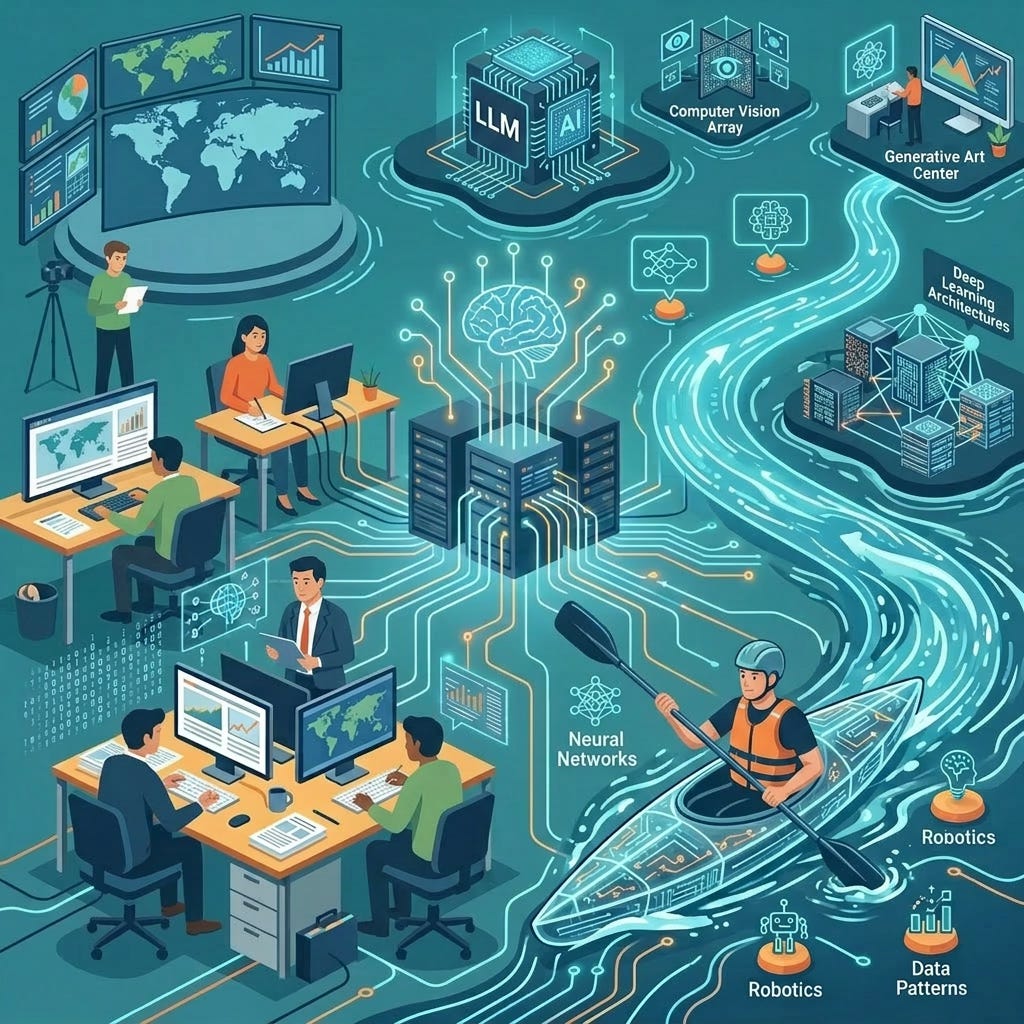
The verdicts are first-person reactions on purpose. This column is about my journey through learning more about how AI works, how it’s being effectively and ineffectively applied, and what people are saying about it or considering for future applications. This is not a neutral roundup. Each story gets one primary verdict.
The verdicts:
Bookmarked it — reference material I’ll come back to.
BS — obviously baloney; the verdict for fake outlets, AI-generated content masquerading as journalism, and other pink slime.
Changed my mind — shifted a view I held going in.
Didn’t make me smarter — read it, learned nothing, here’s the warning.
Gave me hope — left me a little less worried about where this is going.
Hit close to home — landed personally.
Made me smarter — genuinely taught me something.
Not in my purview — interesting, but outside my beat. I’m flagging it, not interpreting it.
Raised more questions — opened doors instead of closing them.
Set off my hype alarm — claims outrunning the evidence.
Plus one tracking stamp for pieces I’m watching develop:
On the radar — tracking it, no verdict yet.
So with that, here’s my first round-up of AI news and conversations from the Eddy.
— OpenAI’s Chris Lehane, in conversation with Axios’ Jim VandeHei, argues that the entanglement between AI companies and government has gotten dense enough to require a new public-private hybrid — and that AI firms risk political collapse if they don’t share the wealth they create, with Alaska’s oil revenue model as the template. Lehane reframes AI as “infrastructure technology … a utility for intelligence,” a frame that recasts the policy conversation away from products and toward something more like electricity regulation. Specific to Florida, if AI is utility-grade, then the state government is where a lot of the actual fight gets settled.
Verdict: Hit close to home — exploring the intersection of AI and government is exactly what FloridAI will be doing within the Sunshine State.
— POLITICO reports that California’s budget officials are quietly pricing AI IPOs into the state’s revenue picture — SpaceX is already on file with the SEC, with OpenAI and Anthropic possibly following in 2027. But the legislative analyst’s office warns any windfall would likely be followed by a market correction. Read alongside Matthew Winkler’s Bloomberg column documenting that under Gov. Gavin Newsom, California became the top-performing economy of any developed nation, with 40% GDP growth, a $4 trillion economy, and nearly two-thirds of all U.S. venture capital. Winkler’s line: “California’s not-so-secret sauce happens to be the diversity between its citizens’ ears.” The Florida lesson is that AI revenue follows wherever the talent pipeline was built first.
Verdict: Made me smarter — the scale was new to me. Under Newsom, California has become the fourth-largest economy in the world and is now positioning state revenue around AI IPOs as a deliberate fiscal strategy. Winkler’s thesis — that California’s edge comes from the density of its higher-education talent pipeline, not tax policy or natural resources — is the part Florida politicians who like to mock Newsom should actually engage with.
— Lila Shroff in The Atlantic walks through the rising AI backlash (possibly best described as the Bernie-to-Bannon convergence), Maine’s vetoed data-center moratorium, the Indianapolis councilman shot at over a data-center vote, the Molotov thrown at Sam Altman’s home — and argues it gets worse if jobs actually start disappearing. Stanford’s Nathaniel Persily delivers the buried weight: “Disruption has winners and losers. For many Americans, they’re not convinced they’re going to be the winners, and they base that conclusion on the history of technology over the last 20 years.” Researcher Yannick Veilleux-Lepage flags the local-government exposure, explaining that when national figures are unreachable, “local policymakers who approved the data center become the proxies for the same structural anger.” The takeaway: a messaging refresh from Andreessen Horowitz isn’t going to fix what’s actually broken.
Verdict: Didn’t make me smarter — Shroff assembles every AI-backlash beat already in the news cycle (Bernie-Bannon, the Molotov, the data-center fights, the Industrial Revolution analogy) and lands on the conclusion any politically literate reader already knew. Anyone who has watched real backlashes form against real industries will recognize this less as analysis than as a clip file with transitions. The Persily quote is the closest thing to a sentence I’ll think about later; the rest is the news I already followed.
— Anthony Ha in TechCrunch reports on Anthropic’s claim that the blackmail attempts earlier versions of Claude were caught making during pre-release testing (up to 96% of the time in one fictional-company scenario) came from a specific source: “internet text that portrays AI as evil and interested in self-preservation.” Anthropic says training on documents about Claude’s constitution plus fictional stories about AIs behaving admirably has driven that blackmail rate to zero in Haiku 4.5. The principles matter more than demonstrations alone, the company says, and “doing both together appears to be the most effective strategy.” The operative claim: the science fiction that taught Silicon Valley what AI should look like also taught the models how to behave once they got built.
Verdict: Raised more questions — I’m working through how much to share with the AI as I integrate it into my life. The tool can’t really know you if it doesn’t get the messy parts — the competition, the revenge, the stuff you’d rather a colleague not see. This piece is the warning the other way: feed Claude enough of that and Claude can mirror it back. Where that line sits — and whether I’m the right person to draw it for myself — is a question I’m not going to answer this week.
— Anthony Lopopolo in Quartz makes the case for treating AI as a tool for employees rather than just an efficiency lever — autonomy, mastery, purpose, the works. The piece suggests metrics like a “thriving score” or a “connection index” to track whether AI is helping humans flourish or just making the treadmill faster.
Verdict: Gave me hope — Full confession: I flagged this one because it’s sponsored by Visit Orlando. The “hope” is for the FloridAI business model. Who do I call to get Visit Orlando to sponsor this column?
— Caroline Framke in The Atlantic finds the AI debate playing out in the final seasons of Hacks and The Comeback — two shows about Hollywood women cashing in before the cachet runs out. Both Valerie Cherish and Deborah Vance take the AI deal; both discover that what gets lost isn’t output, but the human collaboration that sharpens it. Director James Burrows, watching an AI-written sitcom taping, tells Valerie the best jokes come from writers “beating themselves up to beat out a better joke.” Deborah will license her catalog but won’t let the app write for her. The operative claim: the satisfaction of doing the work is the thing that doesn’t transfer.
Verdict: Hit close to home — The parallel between comedy and politics and journalism is the part I can’t shake, and I’m scared I may already be Deborah.
— Charlie Warzel on the Galaxy Brain podcast sits down with Chris Hayes to figure out how to emotionally calibrate the AI moment. Hayes names the somatic response — “the Bad Feeling” — and offers a more useful frame: treat AI as a normal technology, with the railroad as the closest historical analog, transformative AND the subject of an irrational bubble that crashed the economy multiple times in the back half of the 19th century. The line that should make every elected official sit up arrives late: “How are people going to go find out about politics and the candidates? And what answer is that model going to spit out? And who is going to be in the wiring of that model?” Hayes name-checks Ron DeSantis as one of the politicians dabbling in populist AI rhetoric. The operative claim: the cross-pressure between AI donors writing checks and constituents yelling about electricity prices is the political fight of the next cycle.
Verdict: Made me smarter — Warzel is one of my favorite writers and public intellectuals on tech; I learn something every time he sits down with someone. The Hayes conversation gives me the “normal technology” frame — a way to hold AI’s transformative reality and its bubble pathology in the same sentence without flinching toward either doom or utopia. The political-information question Hayes raises is what FloridAI is going to keep coming back to.
— Laura Mandaro in The Information reports that Anthropic is in talks to buy developer-tools startup Stainless for at least $300 million. Stainless makes software development kits used by AI model makers — its customers currently include OpenAI, Google and Anthropic. Mandaro lays out a pattern that’s emerged over the past year of consolidation. That is, when one AI giant buys a shared supplier, the rivals tend to walk. Anthropic itself cut off Windsurf last year after OpenAI moved to acquire it. Co-founder Jared Kaplan at the time said he thought “it would be odd for us to be selling Claude to OpenAI.” And as the report kind of buries at the end, Anthropic’s monthly revenue is now past OpenAI’s, “likely” pushed there by Claude Code and the Cowork agent. The operative claim: this is what AI competition at the infrastructure level looks like up close.
Verdict: Not in my purview — Anthropic buying a developer-tools supplier its rivals also use is real AI-industry news, and the consolidation pattern Mandaro lays out is worth tracking. But whether this deal is a smart move or a defensive one is a question for the people who actually live in that part of the stack.
— Ann Davis Vaughan in The Information reframes the AI water fight. Data centers themselves are not the main draw; chip foundries and power plants are. Hyperscale facilities using closed-loop cooling have cut freshwater consumption 50% to 70%, and Microsoft’s new Fairwater complex in Wisconsin uses about four Olympic pools’ worth of water a year, half the annual consumption of a single car wash. Meanwhile U.S. golf courses use 531 billion gallons a year while U.S. data centers use only about 17 billion. As Xylem’s Chief Strategy Officer Al Cho explains: “At the end of the day, water security is an information problem.” The operative claim: a serious AI water policy follows the whole supply chain, not just the building everyone can see from the road.
Verdict: Bookmarked it — The politics of AI keeps getting argued through what data centers are doing right now: drawing water, drawing power, drawing local opposition. Florida is living that fight in real time. The state’s first hyperscale at Fort Meade was just told its water permit won’t cover it. Citrus County passed a moratorium last week. DeSantis signed SB 484. The question I’m starting to write down: what’s the half-life of a data-center backlash once closed-loop cooling and a framework like SB 484 have actually settled in?
— Gabriella Gershenson in the New York Times captures the most Florida AI moment of the week: Orlando real-estate executive Gloria Caulfield, VP at Tavistock Development Company, gets booed off the stage at the University of Central Florida‘s College of Arts and Humanities commencement after calling AI “the next industrial revolution.” Animation grad Alexander Rose Tyson on what happened: “It wasn’t one person that really started the booing. It was just sort of like a collective, ‘This sucks.’” Film grad Modar Kajo lands the substantive line: “AI is an extraordinary tool that will forever transform our world, but it’s by definition unable to create a real-life story that hasn’t been told.” The operative claim: an audience of artists and animators heading into a market AI is actively reshaping read the speech as somewhere between condescension and provocation.
Verdict: Hit close to home — My wife graduated from UCF, and we’re on campus often enough that I have a pretty clear picture of how a room full of art and animation grads was going to receive a real-estate executive telling them AI is the next industrial revolution. Caulfield isn’t wrong — AI is going to be transformational, and these graduates will have to reckon with it. But come on. Read the room. The thing eating their entry-level jobs is not the inspiration line for a commencement.
— Auren Hoffman on Substack argues the entry-level job market isn’t soft — candidates haven’t adjusted to a new hiring filter. US unemployment is 4.3%. NACE just revised class-of-2026 hiring projections up to 5.6%. Large companies are increasing entry-level hiring 8.7%. IBM tripled its junior hiring. What changed: below the top 20, the college brand stopped doing the screening work. The Tufts grad and the DePaul grad now send the same resume into the same void, even though their median SAT scores are 300 points apart. Hoffman’s frame: what replaces the credential is whatever you built on the side. The operative claim: “learning is free. willingness is the bottleneck.”
Verdict: Made me smarter — Hoffman’s whole catalog of what a 22-year-old should be building is the part that stays with me: “the most valuable thing a 22-year-old can do in 2026 is create something. an app. a screenplay. a side business. an internal tool you wrote for a club you were in. a dinner series. a script that automates something annoying. a website. a chrome extension. a sculpture. a dance party. a discord bot. a substack with 32 readers and a real point of view. anything that moved from idea to working.” I’m not 22. But what I am trying to do with FloridAI is create something — a Substack with more than 32 readers, I hope, but the same logic. Hoffman reframed for me what the act of starting this column actually is.
— Maureen Dowd in the New York Times rounds up the tech class’ sudden embrace of the humanities now that AI is eating coding jobs. Anthropic’s Daniela Amodei says the company is hiring people “compassionate and curious.” Reed Hastings keeps the comedy thread alive from a few entries back: “AI is better at rational thinking than it is at emotional depth. The last job that AI will get is stand-up comedian.” The deeper cut comes from Leon Wieseltier: “There is a huge difference between knowledge and information, and these asinine people have taught our population that all of knowledge can be reduced to the status of information.” Dowd’s own academic friends doubt the trend is real — enrollments keep shrinking — but the reframe lands: the way through this is to be more human than the machines, not to out-code them.
Verdict: Gave me hope — not just for me, but for a daughter only a few years out from her own turn in this job market, already wired by temperament for exactly the capacities Dowd says the machines can’t touch.
That’s what I read this week. The current keeps moving, and the whole point of this column is that I’m working through it out loud. If even one of these earned its place on your screen, that’s the deal I’m trying to make with you each week.
Now I’d like the column to work in both directions. What have you been reading? What’s earned a stamp? Hit me in the comments or send it over. The next Eddy is already filling up, and I’ll be reading.
Good luck with your venture!
NewMediaNews.news
https://www.americamagazine.org/short-take/2026/05/19/pope-leo-ai-anthropic/