From the Eddy
A regular feature about what Peter is reading as he explores the intersection of AI and politics.

This is what I read about AI this week, with one-stamp verdicts. The stamps are first-person reactions on purpose. This column is about my journey through this stuff, not a neutral roundup. Each story gets one primary verdict.
The verdicts:
Bookmarked it — reference material I’ll come back to.
BS — obviously baloney; fake outlets, AI-generated content masquerading as journalism, pink slime.
Changed my mind — shifted a view I held going in.
Didn’t make me smarter — read it, learned nothing, here’s the warning.
Gave me hope — left me a little less worried about where this is going.
Hit close to home — landed personally.
Made me smarter — genuinely taught me something.
Not in my purview — interesting, but outside my beat. I’m flagging it, not interpreting it.
Raised more questions — opened doors instead of closing them.
Set off my hype alarm — claims outrunning the evidence.
Plus Florida implications, when the connection is the point.
Plus one tracking stamp for pieces I’m watching develop:
On the radar — tracking it, no verdict yet.
Back on dry land, back in the eddy. The last edition came to you from airport lounges and somewhere over the Atlantic. This one’s from the desk, Claude humming on the second monitor.
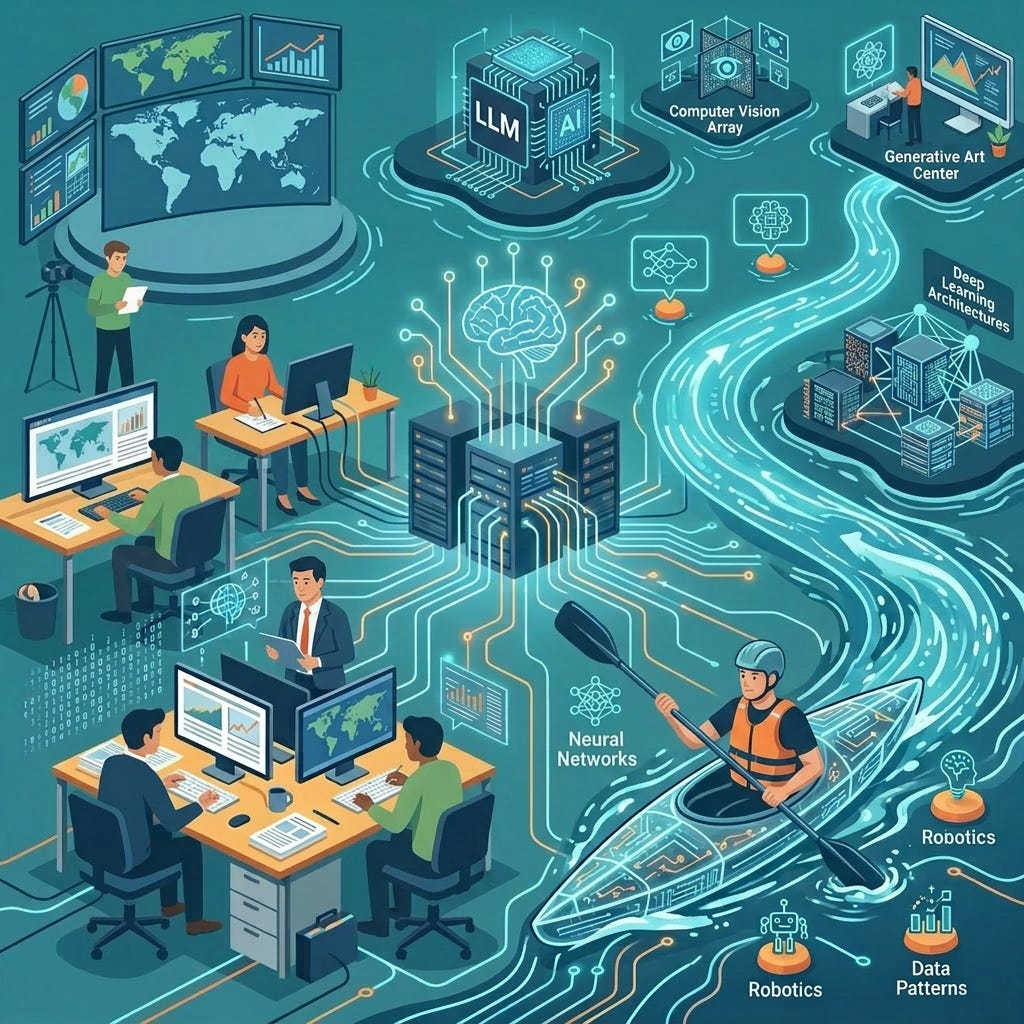
It was the week the abstraction fell away. AI stopped being something we debate in theory and became something happening to people with power — the White House switching off the most capable models in the country inside 90 minutes, super PACs wiring tens of millions into House races, China quietly taking the open-source layer while our own labs chase trillion-dollar IPOs. The fight is here. It’s about money, language and control. And Florida is sitting in the middle of more of it than you’d think.
Eight pieces earned a stamp. Here’s what I read.
— The Atlantic’s Matteo Wong reports on the White House declaring Anthropic’s most powerful models a national-security threat — Anthropic got 90 minutes to pull Fable 5 and Mythos 5, then an export control that forced it to shut the bots down for every customer, the U.S. government included. The cited jailbreak is contested; cybersecurity CEO Katie Moussouris, who reviewed the government’s own report, called it “the model working as intended” for cyberdefense. The deeper issue is precedent: By forcing a shutdown, the export control quietly becomes the FDA-for-AI licensing regime the White House swore its own executive order would never create. AI-law expert Alan Rozenshtein names the paradox — a fast-moving, dangerous technology is “exactly the situation in which you need to give the executive an enormous amount of discretion,” yet a President who plays favorites is “exactly the reason why you don’t want to.” Wong’s bottom line: America has plenty going for it in the AI race, and right now the White House isn’t one of them.
Verdict: Made me smarter — the mechanism is the lesson. Nobody passed a law. An export control is how the federal government just set up de facto preclearance for frontier AI, which is the implementation gap running in reverse: The thing nobody labeled “regulation” is doing more regulating than the executive order that was. That it lands on the company whose tool I write this column with only sharpens it.
— The Washington Post’s Kevin Schaul and Nitasha Tiku lay out, in plain language, how people trick chatbots into breaking their own rules — the exact “jailbreaks” at the center of last week’s White House-Anthropic fight over Fable and Mythos. The methods are almost insultingly simple: tell the model to role-play “DAN” (Do Anything Now), reframe the request as a bedtime story a grandmother used to tell, bury it in a poem (”adversarial poetry,” per Italy’s Icaro Lab), or upload a photo of a handwritten list after the typed version gets denied. Noam Schwartz, CEO of the AI-security firm Alice, gives the honest version: “you can’t fully prevent jailbreaking. Harmful knowledge is already baked into the model, and there’s infinite ways to ask for it.” The takeaway: the guardrail problem isn’t a bug waiting to be patched, it’s a permanent condition.
Verdict: Bookmarked it — but for a different reason than usual. Three months ago I couldn’t have told you what “jailbreak” or “jailbroken” meant. I’d have nodded along and quietly looked it up later. I’d bet a lot of you are in the same spot — intelligent people just starting to explore this, running into a wall of vocabulary the AI crowd tosses around as if everyone was in the room when it got coined. This is the rare piece that just explains the term, cleanly, with examples. I’m keeping it as a reference, and I’d tell you to do the same. We’re all building a shared language for a new technology at the same time, and there’s no shame in not knowing a word yet.
— The Atlantic’s Will Gottsegen (gift link) maps one of the AI industry’s first serious pushes into electoral politics: tech-affiliated super PACs spending tens of millions to soften an electorate that mostly distrusts AI. The model comes straight from crypto’s 2024 Fairshake playbook, now split into two rival camps. Leading the Future — co-founded by Andreessen Horowitz, with more than $140 million reported across its network and OpenAI President Greg Brockman among its donors — runs the regulation-light lane. Anthropic put $20 million behind the other side, Public First Action, which one co-founder calls “the anti–super PAC super PAC.” The proxy war played out in New York’s 12th Congressional District, where tech-aligned groups spent $26 million against pro-regulation candidate Alex Bores and safety-aligned groups spent $18 million for him. Strategist Cooper Teboe called that race “the final exam” for AI money in politics (Bores lost). The takeaway: before a vote is cast, the industry is already deciding how the AI fight gets framed.
Verdict: Bookmarked it — this is exactly the intersection I want to be camped at: super PACs putting real money into campaigns over AI. I’m keeping it as an order of battle — who’s funding what, which side of the regulation fight they’re buying — because that map is about to matter closer to home. It made me smarter on the mechanics, too: the Fairshake-to-AI lineage is the tell for how this scales.
Florida implications — some of the PAC money tied to the players here is starting to circle Florida’s November races. As that develops, this national framework becomes the scorecard for reading who’s spending in the state, and why.
— Axios’ Jim VandeHei reports in the C-Suite newsletter that cheap, powerful, mostly Chinese open-source AI models are seeping into American companies, often unnoticed. The share of token consumption by Chinese models on OpenRouter jumped from about 7% in January 2025 to over 50% by June 2026. Microsoft is weighing DeepSeek to power Copilot on cost, and the agent platform Lindy already switched 100% to DeepSeek V4, citing millions in savings. A top tech exec names the gravity: “If you had to buy the frontier models from the top labs, a lot of people would be priced out. We’re talking about a 10x, sometimes a 100x, price difference.” Dominating open-source is China’s national strategy — backdoor risk and all.
Verdict: Raised more questions — the chart is the question. If open-source is China’s national strategy and Chinese models are already past half of token consumption while our labs optimize for trillion-dollar IPOs, I’m left wondering, uneasily, whether China just wins this race.
— Tampa Bay Times Chair and CEO Conan Gallaty argues that Florida AG James Uthmeier’s lawsuit against OpenAI — which alleges links between ChatGPT and self-harm, suicide, and a planned FSU mass shooting — is finally “a battle worth fighting,” but doesn’t go nearly far enough. Gallaty wants two things the suit leaves out: a requirement that AI companies pay for the content they train on, and publisher-grade accountability for what their systems generate, instead of hiding behind a 1996 liability shield. His line on the IP problem is the one that sticks: “Shoppers choose carefully. Looters grab whatever they can.” The takeaway: accountability has to catch up with capability.
Verdict: Made me smarter — less for the policy fixes than for the window into how a credible newspaper publisher actually sees this. The looters line is the cleanest distillation I’ve read of the view most journalists hold of AI companies — disparaging, sure, but it’s the same instinct my own colleague Janelle Irwin Taylor voiced in our last From the Slack channel, where she described herself as “cautious and skeptical” and worried we aren’t “responsibly harnessing the power of this technology.” When the people who make the information describe the technology as theft, that’s a tell about where this fight is heading.
Florida implications — the Uthmeier-OpenAI suit is becoming the center of gravity for the whole Florida AI beat: a child-safety case that’s also a proxy for the IP and Section 230 fights playing out nationally.
— POLITICO’s Catherine Allen and Noah Baustin map more than 200 data centers going up across competitive House seats and find both parties flat-footed on the fallout. Forty of 69 battleground districts have facilities planned or under construction, yet broader party messaging is “essentially nonexistent.” The bookmark-worthy asset is the interactive map of data centers planned or under construction by congressional district — but the sharpest finding is that every congressional and gubernatorial ad mentioning data centers, per AdImpact, attacks them, most aimed at Republicans. Rep. Marcy Kaptur calls the backlash “spontaneous combustion coming up from the grassroots” — no wonder, when Gallup finds 7 in 10 Americans don’t want a data center built in their area. The fight has outrun the strategy.
Verdict: Bookmarked it — the map is the reference asset, a district-by-district scoreboard I’ll come back to as the data center beat develops and the 2028 cost-of-living thesis sharpens.
Florida implications — POLITICO’s competitive-district count already folds in Florida’s redrawn 2026 boundaries, so the map doubles as a live read on which Florida seats carry data center exposure into the midterms.
— Second to last, a sign of the times. The Washington Post’s opinion section is launching “Superintelligent,” a weekly newsletter promising an essay every Tuesday to help readers “understand this tech transformation and what it means for you” — some optimistic, some cautionary. The pitch: “This will be a pivotal moment in human history. Make sense of it with Superintelligent.” I’m flagging it less for what it says than for what it signals. When Post Opinions stands up a dedicated AI newsletter, the beat I launched FloridAI to cover has officially gone mainstream. Everyone’s getting into the AI-newsletter business now.
Verdict: Bookmarked it — actually, I did one better and subscribed. Let’s see what it has to say.
— And to close, the fun one. Esquire’s Ryan D’Agostino spends a tequila-soaked afternoon and a private flight with Dwayne Johnson, and somewhere near the bottom of the bottle the Rock pulls out his phone and discovers ChatGPT. He’s brand new to it — keeps calling it “ChatGCP” — but he’s already a convert: he’d asked it for a workout and “within three seconds it comes back with a training program that’s lights-out, pencils-down spectacular. Like it came from 10 of the greatest coaches I’ve ever worked with.” Then the two of them ask the chatbot whether America wants him to run for President. The line that earns the verdict is his posture toward the whole thing: “We can either stick our heads in the sand and be afraid, or we can say, OK, we’re here. Let’s see. Let’s explore.”
Verdict: Gave me hope — when a 236-pound movie star picks up the same tool I’m wrestling with on my second monitor and decides to explore instead of duck, the optimism is hard not to catch. Let’s see. Let’s explore.
That’s the week. Strip out the valuations, the jailbreak jargon and the ad buys, and the throughline is plain: The people with money and power have decided AI is worth fighting over, out loud, right now — while the rest of us are still learning the vocabulary. That’s the whole reason I’m doing this. Reading it in real time so we build the shared language together, a few weeks before it lands on your doorstep as a data-center hearing or a campaign mailer.
No eddy this week. There rarely is. The current’s moving too fast to duck behind a rock.
Now your turn. What earned a stamp on your reading list this week? Drop it in the comments or send it my way. The next edition’s already filling up, and I’ll be reading.
Ed. note: This story was drafted with assistance from AI. Editorial judgment, sourcing, and final review were performed by Peter Schorsch and the Florida Politics editorial team.
Yes.